





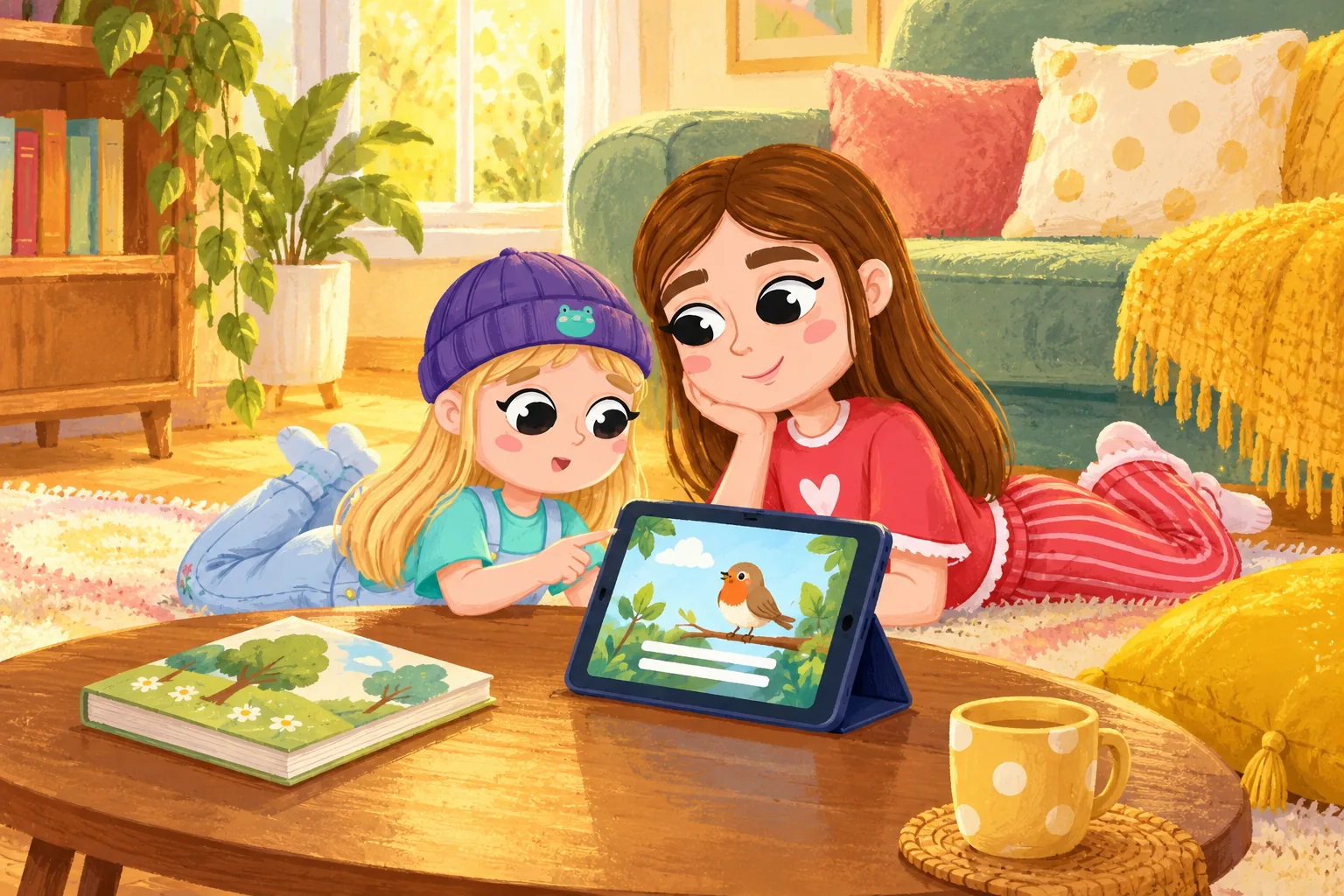
A child's reading corner: start with one book
A child's reading corner can be a comfortable place to open a book, rather than a dedicated part of a bedroom. Start with a seat or patch of floor you already…
 Nina Bakalová20 October 2026 · 8 min read

A child's reading corner can be a comfortable place to open a book, rather than a dedicated part of a bedroom. Start with a seat or patch of floor you already use, suitable light and an accessible book. Try reading there together before deciding whether you need to buy anything.
The book is on the table. Laundry covers the sofa, a television is playing in the next room and your child carries the story into the hallway. That does not automatically mean they dislike reading. They may simply prefer that spot today. It is a useful detail to notice before ordering an elaborate reading tent.
This guide is about arranging an ordinary home for a shared activity. It is not a treatment plan or a list of equipment every child needs. The aim is to make opening a book easier, including on a busy evening when nobody has much energy left.
Test the place before furnishing it
Choose an existing spot: one end of the sofa, a comfortable chair or a clear area of carpet. Bring a familiar book and sit as you normally would when sharing it. Open the book fully. Can both of you see the pictures? Is there room for the format you actually read, rather than the smaller book you used to test the space?
Notice small practical difficulties. An armrest may dig into your elbow. A cushion may keep slipping away. A child sitting beside you may only see half the illustration. Address the difficulty you find. A new shelf will not necessarily solve the problem of a large book balancing awkwardly between two people.
The Scottish Book Trust's guidance on book corners highlights comfort, accessible books and children's involvement in choosing them. Its setting is early years provision. At home, you can take a modest approach: test a place with one book, then change what gets in the way.
Check the light when you actually read
A lovely spot beside a window at breakfast can be dark after dinner. Try it at your usual reading time. Look for shadows across the page and reflections on glossy illustrations. Your child may prefer the book at a different angle from the one that suits you.
You do not need to turn this into a technical lighting project. If you keep leaning forward, shielding your eyes or turning the book to escape glare, move the book or choose another place. Use lamps as intended and keep fittings and cables out of the route in and out. A corner does not need to be enclosed or dim to feel welcoming.
Let the arrangement change with the day. Morning sunlight, an evening lamp and a shared kitchen table offer different conditions. If a temporary place works well, it does not become less valid because it cannot stay set up for a photograph.
Make noise a practical question
Some children dislike conversation in the background. Others enjoy books in the middle of family life. There is no single arrangement that suits all autistic children or all non-autistic children. Begin with what happens in your own room: does turning down the television, moving away from the kitchen or closing a door make this activity more comfortable?
A child covering their ears or moving away can be offered another place or a break. They do not need to justify why the noise bothers them. Our guide to sensory overload in children explores the wider topic. A reading space remains an invitation, rather than the only place a child is allowed to feel comfortable.
Offer a choice the child can use
For a first attempt, set out a small selection of books you already have. You might show one favourite and one different book. This is a practical experiment, not a recommended number for every household. If your child asks for another book, the prepared selection does not have to become a boundary.
Put covers where they can be seen and allow time. A choice may be made by handing you a book, touching a cover or opening a familiar page. It does not have to be spoken. Not wanting a book at that moment also tells you something. Store books safely, without requiring a child to climb unstable furniture to reach them.
Repeated favourites can stay in the selection. You do not have to hide them to make a new purchase worthwhile. See sharing a child's favourite book again for ways to return to a story without turning each reading into a quiz.
An original example: two children on one sofa
The following situation is invented to illustrate choices. It is not a personal family account or a research finding. One child wants the story from the beginning. Another keeps returning to a picture of a dog and closing the book. The adult moves a large cushion between them, and neither has a clear view for long.
The first change could be where everyone sits, rather than how much space the corner occupies. Can both children see a page without leaning over each other? If their preferred pace differs, separate short turns may work better than trying to keep the whole group in step.
Another adult might share a different book with one child, if someone is available. If nobody is, the plan needs to fit that reality. There is no requirement to create an ideal group reading session every evening. Our guide to reading with two children of different ages considers those practical choices in more detail.
When you cannot keep a corner set up
A portable basket or one space in a cupboard can do the job. The books come out, the story is shared and the table goes back to being the dinner table. A familiar starting point can be a book rather than a permanent chair.
You can explain today's arrangement simply: “We'll sit here today.” If it helps your child, show the place rather than giving a long description. There is no need to reproduce an entire bedroom setup at a relative's house. A familiar story and an available comfortable seat may be enough. If the environment is unsuitable, reading can wait.
A household with little spare space does not need to add another daily tidying task. If using the corner means moving several boxes before every story, consider a simpler arrangement. The best setup is one you can use on an ordinary day, not only after a weekend of reorganising.
What to keep out of the first shopping list
A decorative sign, matching storage, themed cushions and a reading chart can all look appealing. None is necessary to open a story together. Before buying an object, name the problem it would solve. “We cannot see the page after sunset” is a clearer reason than “the corner does not look finished”.
Consider maintenance too. A large collection on display may take time to sort. A special seat may suit one child but make sharing a wide book awkward. If you can, try a comparable arrangement using things at home before committing money and space. A library book belongs in a reading corner as much as a newly bought book does.
Review the arrangement, rather than testing the child
After several reading attempts, ask practical questions. Was the book easy to find? Could both of you see it? Was it easy to leave? Those questions are more useful than expecting the child to sit for an extra ten minutes to prove the corner works.
Change one detail at a time if that makes the experiment easier. Move a cushion, reduce glare or offer a different seat. You can reverse any of these changes. The corner does not have to become a permanent statement about what your child likes or needs.
A story to explore together
If you are looking for a picture story about understanding differences, explore the TAMITOS children's book. This is a recommendation of our own product, rather than an independent comparison. Check the available language, format and preview before ordering. We do not promise that a book or reading space will resolve a child's difficulties.
Frequently asked questions
Do we need a reading tent?
No. Start with a safe existing place. An enclosed space is not comfortable for everyone and is not a condition of shared reading.
Must my child remain seated throughout a book?
The child need not hold one position. Look for a safe arrangement that lets you share the page, and allow a break. Movement alone does not establish a lack of interest.
How many books should be on display?
There is no universal correct number. Offer a selection the child can navigate and keep favourite books available. Change it if it is unhelpful.
What if my child chooses somewhere else?
If the place is safe and suitable for reading, try it. A prepared corner is an option, not a rule. It may be useful on another day.
Sources and editorial link check: 20 October 2026. The examples are original TAMITOS illustrations of everyday choices.
Mom of two and co-founder of TAMITOS. For several years I have walked alongside our daughter on the autism spectrum, sharing real experiences from everyday life to bring more understanding and practical information to parents and everyone around them.
More articles
What is Easy Read? Clear information with useful pictures
Easy Read is a way of preparing information so it is easier to read and understand. It involves more than shor…
Baking with children when noise or sticky hands get in the way
When baking with children, offer small jobs they can genuinely choose or decline. A child might arrange paper …
SDH subtitles: more than the spoken dialogue
SDH subtitles give deaf and hard-of-hearing viewers text for dialogue and important sound information, such as…
 Free