
Do Books, Games and Cartoons Actually Help Autistic Children? What the Research Says
Parents are told that the right book, the right game or the right cartoon will help their autistic child. Some of that is true, some of it is marketing.
 Nina Bakalová23 August 2026 · 12 min read
Every few months a new children's book, app or cartoon arrives with a promise attached: this one will help autistic children, and it will teach everyone else to understand them.
We build those things. We also have to live with the gap between what they promise and what the evidence supports. So we went through the research, systematic reviews, meta-analyses and randomised trials, and wrote down what it actually says about books, games and animated series for autistic children.
Some of it is genuinely encouraging. Some of it says the thing everybody repeats is not true.
The short answer
| Medium | What the evidence supports | Where it falls down |
|---|---|---|
| Games | Game-based interventions improved social skills, social behaviour, attention and emotion recognition in autistic children | No effect in adolescents, no effect on core autistic traits, and the gains do not reliably last |
| Animated series | An animated series teaching emotions has been tested in randomised trials, twice, in two languages, and worked | Tested on emotion recognition specifically, not on wellbeing or friendship |
| Books | Sustained, adult-led reading that frames disabled and non-disabled children as friends improved children's attitudes | A one-off book read once has almost no evidence behind it; nobody has properly studied what autism picture books teach children |
| All three | Reliably teach non-autistic children facts about autism | Changing their attitudes is a much weaker, mixed result |
Do games help autistic children?
This is the area with the most data, and the data is real but heavily qualified.
A 2025 systematic review and meta-analysis in Frontiers in Pediatrics pooled 24 randomised controlled trials covering 1,801 participants (Gao et al., 2025). Game-based interventions produced:
- Social skillssignificant improvement (Hedges' g = −0.59)
- Social behaviourssignificant improvement (g = 0.45)
- Cognitionsignificant improvement (g = 0.57), with attention at g = 0.66
- Language, anxiety, parenting stress, core autistic featuresno significant effect
Now the parts that get left out of the press release. The effect on social skills was significant in children (g = −0.81) but not in adolescents (g = −0.16). Trim-and-fill analysis indicated publication bias for several outcomes, meaning the true effects are probably smaller than the numbers above. And the authors' own conclusion is blunt: because of "the limited number and low quality of the included studies," their findings need confirmation from larger, better trials.
A separate meta-analysis of serious games for autistic people (Tang et al., 201934 studies reviewed, 17 pooled) found medium effects for skills generalising to similar situations (g = 0.68) and to more distant ones (g = 0.46), but maintenance over time was small and, for games built on serious-game design principles specifically, not statistically significant.
The honest summary: a well-designed game can teach an autistic child a specific skill, and that learning can transfer beyond the screen. Whether it is still there six months later is an open question, and nobody has shown that games change autism itself, which is fine, because that was never the point.
What about screen time?
The most-quoted figure comes from a study of 202 autistic children and 179 non-autistic siblings aged 8 to 18 (Mazurek & Wenstrup, 2013). Autistic children spent roughly 62% more time on television and video games than on all non-screen activities combined; autistic boys averaged 2.4 hours a day of gaming against 1.6 hours for their non-autistic brothers.
Two caveats worth more than the statistic. First, that data is from 2013before Roblox, before Minecraft's dominance, before phones were the default console. It is still cited as if it were current. Second, it is cross-sectional: it shows a pattern, not a cause. It does not prove screens harm autistic children, and it does not prove they help.
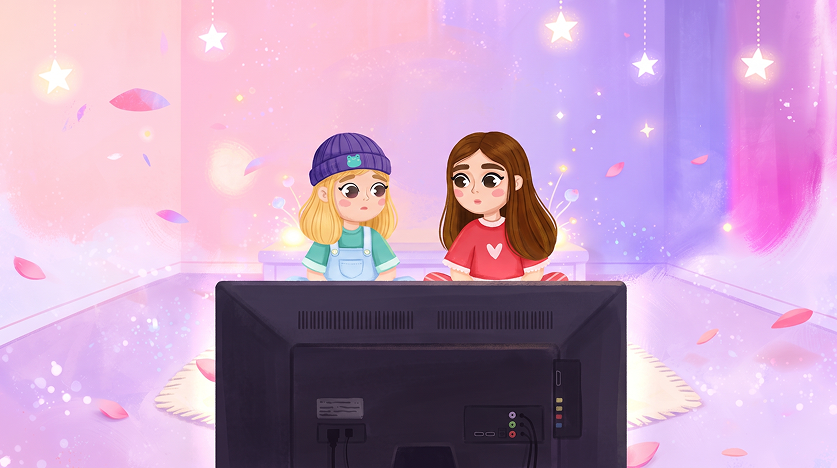
Does an animated series work?
This one has the cleanest evidence, and it is the closest precedent to what an animated series about emotions is trying to do.
The Transporters is an animated series built to teach emotion recognition to autistic children, with real human faces grafted onto animated vehicles. In the original trial, 20 autistic children aged 4 to 7 watched it daily for four weeks, against two matched control groups. The intervention group improved significantly more than the untreated autistic control group on every task level, and by the end performed comparably to non-autistic children (Golan et al., 2010).
That could have been a one-off. It was not. A randomised controlled trial in Hong Kong with 95 children, using a Chinese app version, replicated it: both the autistic and autistic-plus-ADHD intervention groups improved significantly, reached levels comparable to non-autistic children, and the learning generalised to novel situations, while controls did not improve (Chan et al., 2024).
Two independent trials, two languages, two cultures, consistent result. Within its narrow claim, teaching emotion recognition, an animated series demonstrably works.
Emotion recognition training more broadly holds up too, with one important limit. A meta-analysis of 17 randomised controlled trials found computer-based facial emotion training improved emotion recognition (SMD = 0.59), with 9 of 14 studies reporting transfer to other skills, but the gains were not maintained over time, and the training did not produce general improvements in social skills (Zhang et al., 2021).
Which points at something we take seriously: a series that a child returns to, week after week, is doing something a four-week study cannot measure.
Do books about autism change how other children behave?
Here the evidence is thinner than almost anyone admits, and it points somewhere specific.
The strongest result is not about reading a book once. In a six-week classroom intervention with 67 non-disabled children aged 5 to 10, stories featuring disabled and non-disabled children in friendship increased positivity toward disabled peers. The effect was strongest when the stories kept both identities visible rather than smoothing the difference away (Cameron & Rutland, 2006).
Read that design again, because it is the finding: sustained, adult-mediated, friendship-framed reading, not a single book, not a book left on a shelf.
A 2025 meta-analysis of 21 studies and 2,293 children aged 2 to 10 found storybook reading related to empathy, but the effect only held for prosocial skills, not empathy broadly. Reading one-to-one predicted empathy scores; group reading did not (Ciesielska et al., 2025).
And then the uncomfortable part. A content analysis of 35 autism picture books found autistic characters routinely framed as at risk, bullied, isolated, in danger, and criticised the recurring "turning point" moment where an autistic child suddenly produces speech or social reciprocity, which teaches readers to expect a reward for their acceptance (Azano, Tackett & Sigmon, 2017).
A 2024 commentary in Autism Research goes further: concerns have been raised by autistic and non-autistic people alike that some children's books about autism work against neurodiversity rather than for it, and the authors emphasise how little systematic research exists on what these books actually communicate (Venker & Lorang, 2024).
So: books can shift attitudes, under conditions most books are never used in. And the quality of what is on the shelf is contested by the people it is about.
Does putting an autistic character on screen change how children see autism?
This is the claim we most wanted to be true, and it is the one the evidence supports least.
A meta-analysis of interventions using contact to improve children's attitudes toward disability found that in-person contact worked (d = 0.55) and extended contact worked (d = 0.61)but parasocial contact, meaning contact through media, was not statistically significant (Armstrong et al., 2017). The authors state it plainly: "there was no evidence for parasocial contact."
The one experiment done directly with children and cartoons is instructive. Children watched either a Sesame Street segment featuring Julia or an Arthur clip discussing Asperger's syndrome. Knowledge about autism rose significantly in both age groups. Attitudes improved only in the 4 to 7 group, and within that group, only among boys. The 8 to 11 group showed no significant attitude change (Engel & Sheppard, 2020).
A systematic review of autism in fictional media reached a similar place: across the five available impact experiments, there was no significant improvement in autism knowledgeand only a modest effect on attributing positive traits. The reviewers also documented the recurring stereotypes, the savant, autism as burden, repetitive behaviours over-represented and social communication differences under-represented (Jones, Gordon & Mizzi, 2023).
Screens teach facts. Facts are not the same as acceptance. That is not an argument against making the series. It is an argument against pretending a cartoon does the work that a classroom, a playground and a family do.
Why representation still matters
Because the baseline is worse than most people realise.
In a set of studies with hundreds of raters, non-autistic people formed markedly less favourable first impressions of autistic people and were less willing to interact with themjudgments formed within seconds and unchanged by repeated exposure. The critical detail: the bias disappeared when people judged transcripts instead of video. Style, not substance, drives it (Sasson et al., 2017).
Children do this too. In a 2025 study, children aged 5 to 12 watching ten-second clips rated autistic children as more awkward, more aggressive and less likeable, though, encouragingly, their stated willingness to interact was similar (Van Esch et al., 2025).
That is the problem. Familiarity, in the first seconds, is doing the damage. Making autistic children ordinary on screen, not exceptional, not tragic, not a lesson, is a reasonable response to that, even if the measured effect on attitudes is still uncertain.
How the character is written changes the result
One experiment split 147 viewers across three versions of an autistic character: one clip explaining the character's inner experience, one showing them behaving in a relatable, neurotypical-like way, and one showing stereotypical autistic behaviour. Stereotypes were least negative after the informational clipthe one that showed what the character was actually experiencing, and liking the character mediated the effect (Mallipeddi, Dickter & Burk, 2024).
In other words: making an autistic character "just like everyone else" performs worse than letting the audience inside their experience.
What good looks like
Pulling the evidence together, here is what we would look for, in our own work and anyone else's.
In a book
- It is read with a child, more than once, not handed over
- Autistic and non-autistic children appear as friends, not as helper and helped
- No miracle turning point where the autistic child becomes socially typical and everyone claps
- The autistic character wants something of their own
In a game
- Built for autistic children rather than adapted to them: predictable structure, adjustable sensory load, no forced timers
- Teaches something specific and checkable, not "social skills" in the abstract
- Designed to be returned to, because single-course learning fades
- Follows accessibility guidance such as the industry Game Accessibility Guidelinesthere is still no peer-reviewed standard specific to autistic players
In an animated series
- Emotions shown in a form a child can name, which is the mechanism The Transporters trials actually tested
- Autistic people involved in writing and voicing, as with CBeebies' Pablo, Mattel's Bruno in Thomas & Friends and PBS Kids' Carl the Collectornone of which has published outcome evidence, but all of which changed how such characters get made
- Mostly wordless moments, so the same episode works in any language
Frequently asked questions
Do video games help autistic children? For children, yes, within limits: a meta-analysis of 24 randomised trials found significant improvements in social skills, social behaviour, attention and emotion recognition. Effects were not significant in adolescents, did not touch core autistic traits, and often were not maintained over time.
Can a cartoon teach my autistic child to recognise emotions? There is real evidence for this specific claim. The Transporters, an animated series built to teach emotions, improved emotion recognition in two independent randomised trials, in the UK and Hong Kong, with children reaching levels comparable to non-autistic peers.
Will reading a book about autism make my child's classmates more accepting? Reading one book once probably will not. A six-week programme of adult-led stories showing disabled and non-disabled children as friends did improve attitudes. The framing and the repetition are doing the work.
Does seeing an autistic character on TV change children's attitudes? It reliably teaches them facts about autism. The evidence that it changes attitudes is thin and mixed, a pooled analysis found media-based contact non-significant, and the one children's cartoon experiment found attitude change only in 4 to 7-year-olds, and only in boys.
How common is autism? The CDC's most recent surveillance estimate is 32.2 per 1,000 eight-year-olds, about 1 in 31, across 16 US monitoring sites in 2022. The global median from a systematic review is about 1 in 100. These measure different things and are not directly comparable.
Where this leaves us
The strongest evidence in this entire field is not about a product. It is about contactreal children, spending real time together, with an adult framing it as friendship. Books and games and cartoons are, at best, ways to make that contact more likely and less frightening.
That is a smaller claim than the ones usually made for children's media. We think it is also a more useful one, because it tells you what to do with a book once you have bought it.
Sources
- Gao et al. (2025), Frontiers in Pediatricsgame-based interventions, 24 RCTs, 1,801 participants
- Tang et al. (2019), Research in Autism Spectrum Disordersserious games meta-analysis
- Zhang et al. (2021), Autism Researchfacial emotion training, 17 RCTs
- Golan et al. (2010), JADDThe Transporters
- Chan et al. (2024), AutismTransporters RCT, Hong Kong
- Mazurek & Wenstrup (2013), JADDscreen use in autistic children and siblings
- Cameron & Rutland (2006), Journal of Social Issuesextended contact through story reading
- Ciesielska et al. (2025), Early Education and Developmentstorybook reading and empathy
- Azano, Tackett & Sigmon (2017), AERA Opencontent analysis of 35 autism picture books
- Venker & Lorang (2024), Autism Researchwhat messages do autism children's books send?
- Armstrong et al. (2017), Disability and Health Journalcontact interventions meta-analysis
- Engel & Sheppard (2020), JADDcan cartoons improve attitudes towards autistic peers?
- Jones, Gordon & Mizzi (2023), Autismautism in fictional media, systematic review
- Mallipeddi, Dickter & Burk (2024), JADDportrayal and stereotypes
- Sasson et al. (2017), Scientific Reportsthin slice judgments of autistic people
- Van Esch et al. (2025), JADDchildren's first impressions of autistic children
- CDC ADDM (2025), MMWR Surveillance Summariesautism prevalence, 2022
- Zeidan et al. (2022), Autism Researchglobal prevalence of autism
Mom of two and co-founder of TAMITOS. For several years I have walked alongside our daughter on the autism spectrum, sharing real experiences from everyday life to bring more understanding and practical information to parents and everyone around them.
More articles
Autism support in Slovakia: where to get help, organisations and contacts (2026)
After the words "it is autism", nobody hands you a map. This is the one we wish we had: where to go in Slovaki…
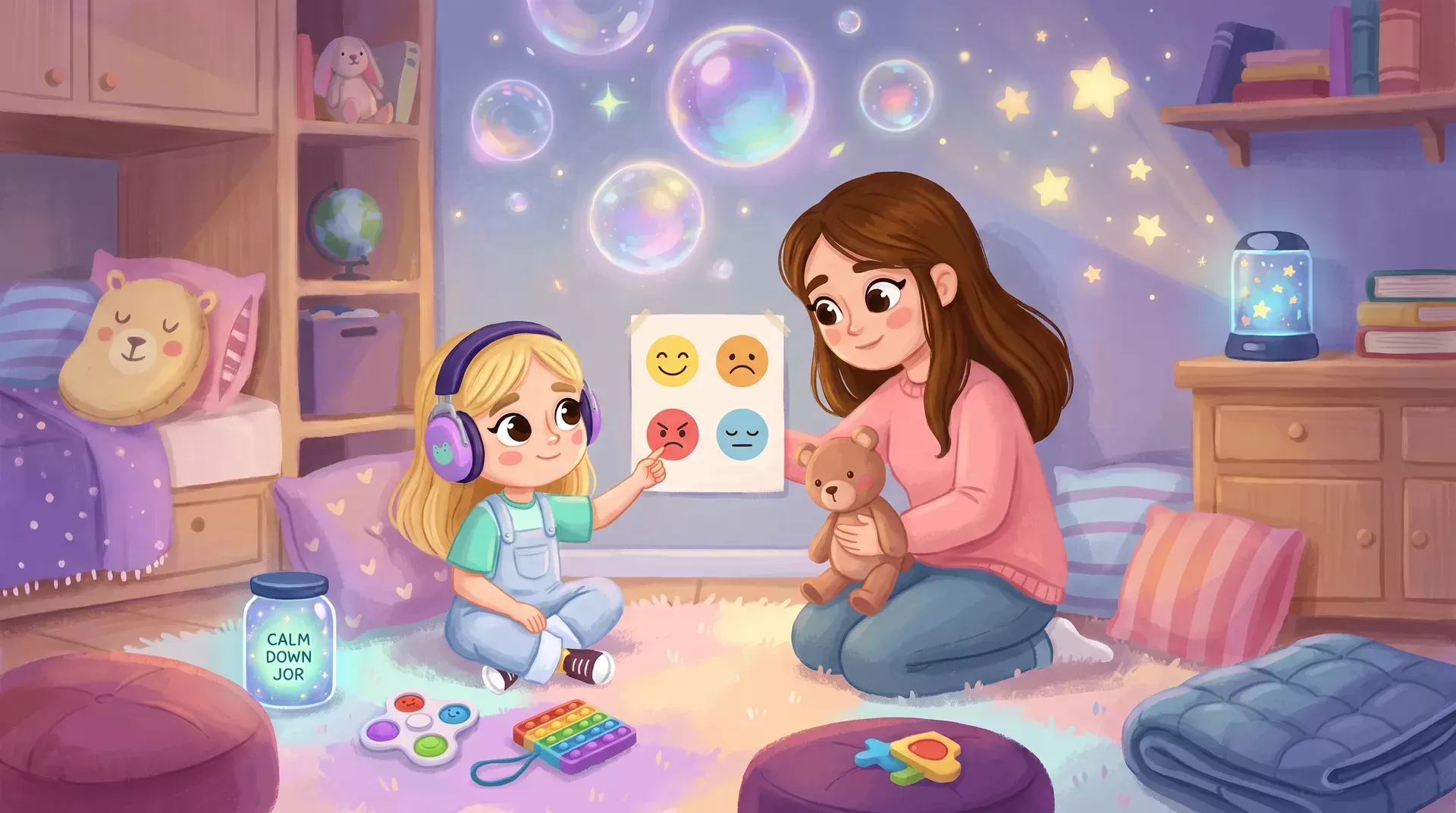
How to Help an Autistic Child Name & Manage Big Emotions
Short answer: You help an autistic child manage big emotions by co-regulating, lending them your calm before …
Are Siblings of Autistic Children More Empathetic? What the Research Really Shows
You have probably read that brothers and sisters of autistic children grow up unusually empathetic. It is a lo…


