






How to Help an Autistic Child Name & Manage Big Emotions
Short answer: You help an autistic child manage big emotions by co-regulating, lending them your calm before you expect any calm back.
 Nina Bakalová30 August 2026 · 17 min read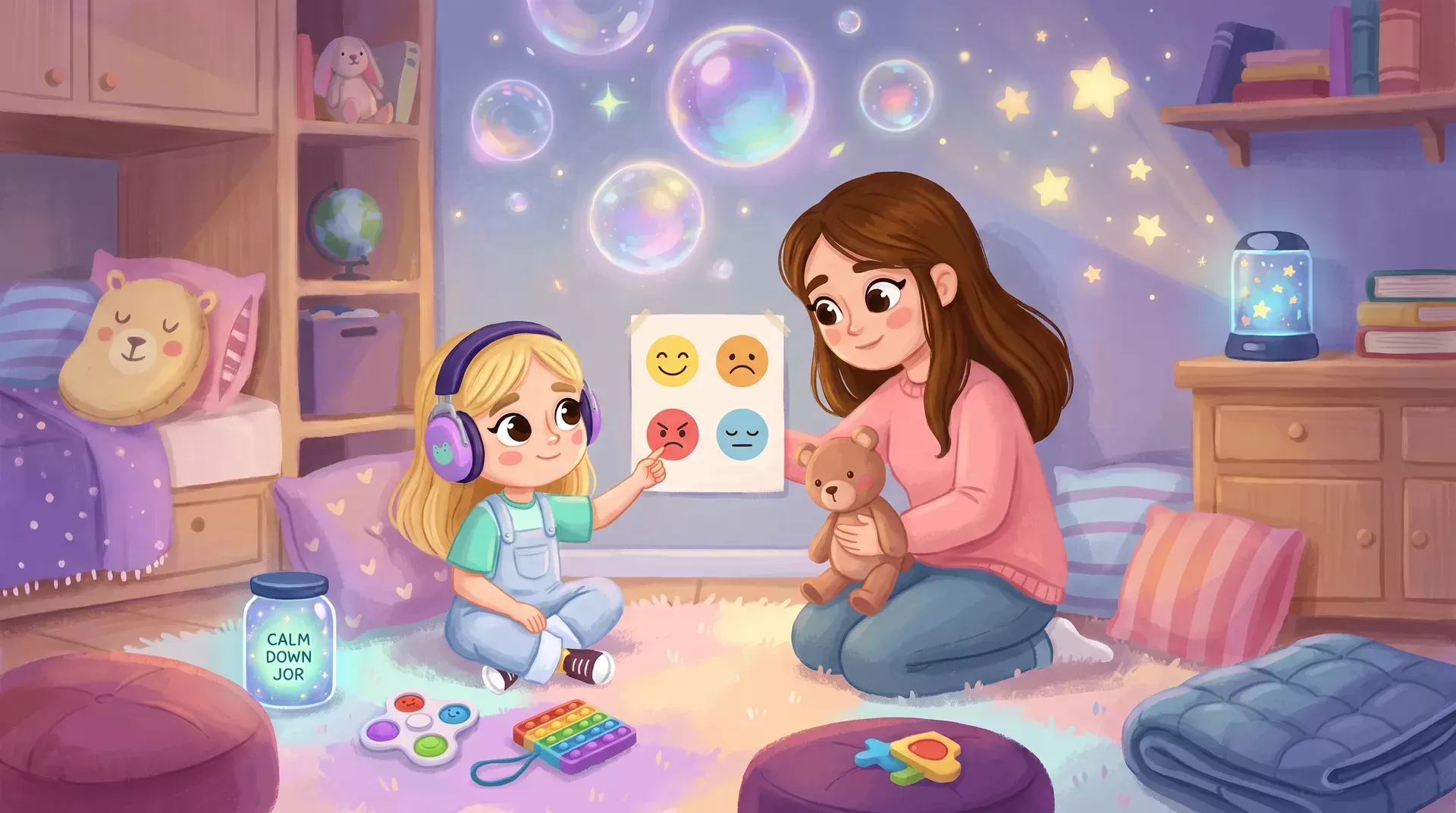
Key takeaways
- A meltdown is involuntaryan overwhelmed nervous system, not a choice, so rewards, bargaining and discipline don't work and can make it worse.
- Co-regulation comes first. A child borrows calm from a calm adult; self-regulation grows out of that, over years.
- Many autistic children genuinely struggle to feel and name emotions (alexithymia and interoception differences), so "I don't know how I feel" is often true, not evasive.
- Prevention beats de-escalation: predictable routines, visual schedules and sensory support stop most overwhelm before it starts.
- Teach and practise calming tools when your child is calm, not in the middle of the storm.
Why big emotions can feel bigger for autistic children
Every child has meltdowns sometimes. For autistic children, big emotions can arrive faster, feel more intense, and be harder to put into words, for reasons that are rooted in how their brain and body process the world.
Two of those reasons are worth naming, because they change how you respond:
- Alexithymiadifficulty identifying and describing your own emotions, and telling them apart from physical sensations. It's a co-occurring trait, not autism itself, but it's common: research suggests up to around half of autistic people experience some degree of it, compared with roughly 1 in 10 of the general population.
- Interoception differencesa reduced ability to notice the internal body signals (a racing heart, tight chest, a knot in the stomach) that emotions are partly built from. If the signal is faint or confusing, the feeling is hard to catch and name in time.
The practical takeaway: when your child can't tell you what's wrong, it's usually not defiance. The feeling may be real and huge, but genuinely out of reach for them to label, which is exactly where you come in.
Meltdown vs tantrum: the difference that changes everything
This is the single most useful distinction for parents, because the two need opposite responses.
| Tantrum | Meltdown | |
|---|---|---|
| What it is | Goal-directed behaviour | Involuntary response to overwhelm |
| In the child's control? | Largely yes | No, control is lost |
| Needs an audience? | Often | No, can happen completely alone |
| Responds to rewards/consequences? | Yes | No, and they can make it worse |
| What helps | Calm, consistent boundaries | Safety, less sensory input, co-regulation |
A tantrum is driven by wanting something and tends to stop once the goal is met or calmly not rewarded. A meltdown is what happens when a child's coping capacity is exceeded by sensory, emotional or social overload, the nervous system simply tips over. The child isn't choosing it and can't be reasoned or rewarded out of it.
There's also a quieter version worth recognising: a shutdown, where a child goes still, withdrawn and unresponsive instead of exploding. It's the same overwhelm, turned inward.
Remember: disciplining a meltdown is like punishing a sneeze. The behaviour isn't the problem to fix, the overwhelm underneath it is.
Co-regulation: how to actually help in the moment
Co-regulation means a trusted adult helping a child settle their emotions in real time, literally lending them a calmer nervous system. It's not spoiling or coddling; it's the developmental step that self-regulation is built on. Autistic children often need it more explicitly and for longer, and that's completely normal.
The golden rule: you regulate first. You cannot pour calm from an empty, frazzled cup. Your steady breathing, low voice and relaxed body are the intervention.
A simple, research-backed order to keep in mind is Regulate → Relate → Reason: help the body feel safe first, connect emotionally second, and only talk it through once your child is genuinely calm.
Before: catch the warning signs
Most meltdowns have a build-up, sometimes called the "rumble" stage. Learn your child's early signals: pacing, repeated questions, more stimming, going quiet, or a change in tone. Keeping a short diary of what happened before incidents (time, place, noise, hunger, tiredness) is the fastest way to spot patterns and head them off.
During: soothe, don't solve
- Keep your own calmdon't match their intensity.
- Make it safemove hazards and give space.
- Turn the world downdim lights, lower noise, reduce crowding, offer a quiet spot.
- Use very few wordsshort and clear, and expect slow responses. Talking too much adds load.
- One calm person, not several adults intervening at once.
- Offer comfort on their termsa hug, deep pressure or a weighted item only if welcomed, and let them stim; it helps them cope.
After: recover, then reflect
A meltdown is exhausting. Give your child time and privacy to come back down, and don't lecture or hand out consequences in the aftermath, it only adds anxiety. Much later, when everyone is calm, you can gently look back together, "That was a lot. What do you think set it off?", as problem-solving, never punishment.
Building emotional literacy (so feelings get smaller over time)
You can't teach emotion-naming during a storm, but you can build it steadily in calm, everyday moments so your child has words ready.
- Name it to tame it. Coined by Dr. Dan Siegel and Dr. Tina Payne Bryson, this reflects real brain science: putting a feeling into words calms the brain's alarm centre. At first you supply the label, "You're frustrated, you wanted the blue cup", and your child slowly borrows the vocabulary. Avoid "calm down" or "you're fine," which dismiss the feeling.
- Make feelings visual. Emotion faces, feelings charts, and personalised social stories work because many autistic children process pictures more easily than in-the-moment speech.
- Connect body to feeling. Gently help your child notice where a feeling lives, "Is your tummy tight? Sometimes that's worry", one body part at a time, always as an invitation, never a test.
- Use intensity scales. A 1 to 5 "feelings thermometer" helps a child tell "a bit annoyed" from "really angry," which makes big feelings feel more manageable.
- Colour-zone systems. Some families use colour-coded approaches that sort feelings into a few zones, each paired with coping tools. The Zones of Regulation® (created by Leah Kuypers) is the best-known formal curriculum; you can also use the general idea of grouping feelings by "energy" and matching a tool to each.
This is exactly where gentle stories and characters help: a book or show that gives each feeling a face and a name turns something invisible into something a child can hold, point to, and talk about. (It's the whole reason we built the TAMITOS characters, one friend for each feeling.)
Prevention: routines, predictability and sensory support
Most emotional overwhelm is built upstream, from too much sensory input and too little predictability. Prevention does more than any in-the-moment technique.
- Visual schedules make "what happens next" concrete and lower anxiety, especially around transitions and changes. Preview changes in advance and reassure your child that other routines stay the same.
- Sensory supportsnoise-reducing headphones, tinted glasses, a weighted lap pad, fidget tools, calming music, and a designated quiet corner, help many children stay regulated.
- A "sensory diet"a personalised daily plan of movement and calming input, can be very effective, but it should be designed with an occupational therapist, because the right mix is different for every child.
- A low-arousal approach (fewer demands, less clutter, less confrontation) lowers everyone's baseline stress.
What to avoid
Some well-meant responses backfire:
- Punishment, lecturing or consequences during or right after a meltdown.
- Rewards, bribes or bargaining as if it were a tantrum.
- Forcing eye contactit's often uncomfortable for autistic children and adds stress; it isn't needed to listen or connect.
- Flooding them with words, or saying "just calm down" / "you're fine."
- Physical "coping" tricks that use discomfort or pain (cold, shock, pinching), never safe, never recommended.
- Restraintavoid except to prevent immediate serious injury, and seek professional guidance.
When to seek professional support
This guide is general, supportive information, not medical advice, and every autistic child is different, so the real goal is to build your child's own toolkit. Do reach out to a professional (your paediatrician, an occupational therapist, a psychologist, or your child's care team) if meltdowns are frequent, escalating or involve self-injury, if you suspect pain or a medical or sleep cause underneath them, or before starting weighted products or a sensory diet.
Frequently asked questions
What's the difference between a meltdown and a tantrum? A tantrum is goal-directed behaviour a child can largely control and usually stops once the goal is met or calmly not rewarded. A meltdown is an involuntary response to being overwhelmed, the child loses control, it can happen even with no audience, and rewards or discipline don't help.
How do I calm my autistic child during a meltdown? Stay calm yourself, make the space safe, and reduce sensory input (lights, noise, crowds). Use very few words, offer comfort only if it's welcomed, allow stimming, and give time to recover afterwards. Don't reason, lecture or discipline mid-meltdown.
Why can't my autistic child tell me how they feel? Many autistic children have difficulty noticing and naming their own emotions (alexithymia) and reading internal body signals (interoception). "I don't know" is often genuine. You can help by naming feelings for them and using visuals during calm moments.
What is co-regulation? Co-regulation is a calm adult helping a child manage emotions in real time, through steady tone, breathing and presence. It's the foundation that independent self-regulation grows from, and autistic children often need it more and for longer.
Do weighted blankets and deep pressure help? Many children find deep pressure calming, but only when they welcome the touch, and weight and fit should suit the child, ideally guided by an occupational therapist. It's an offer, never something to impose.
How can I prevent autism meltdowns? Reduce triggers before they build: keep predictable routines, use visual schedules, preview changes, and provide sensory supports and downtime. Watch for early warning signs and step in gently during the "rumble" stage.
*TAMITOS is a gentle universe that helps children name their feelings and helps families feel understood, through a picture book, an animated series and a game where every big feeling has a friend. Explore the TAMITOS world at tamitos.com.## Key takeaways
- A meltdown is involuntaryan overwhelmed nervous system, not a choice, so rewards, bargaining and discipline don't work and can make it worse.
- Co-regulation comes first. A child borrows calm from a calm adult; self-regulation grows out of that, over years.
- Many autistic children genuinely struggle to feel and name emotions (alexithymia and interoception differences), so "I don't know how I feel" is often true, not evasive.
- Prevention beats de-escalation: predictable routines, visual schedules and sensory support stop most overwhelm before it starts.
- Teach and practise calming tools when your child is calm, not in the middle of the storm.
Why big emotions can feel bigger for autistic children
Every child has meltdowns sometimes. For autistic children, big emotions can arrive faster, feel more intense, and be harder to put into words, for reasons that are rooted in how their brain and body process the world.
Two of those reasons are worth naming, because they change how you respond:
- Alexithymiadifficulty identifying and describing your own emotions, and telling them apart from physical sensations. It's a co-occurring trait, not autism itself, but it's common: research suggests up to around half of autistic people experience some degree of it, compared with roughly 1 in 10 of the general population.
- Interoception differencesa reduced ability to notice the internal body signals (a racing heart, tight chest, a knot in the stomach) that emotions are partly built from. If the signal is faint or confusing, the feeling is hard to catch and name in time.
The practical takeaway: when your child can't tell you what's wrong, it's usually not defiance. The feeling may be real and huge, but genuinely out of reach for them to label, which is exactly where you come in.
Meltdown vs tantrum: the difference that changes everything
This is the single most useful distinction for parents, because the two need opposite responses.
| Tantrum | Meltdown | |
|---|---|---|
| What it is | Goal-directed behaviour | Involuntary response to overwhelm |
| In the child's control? | Largely yes | No, control is lost |
| Needs an audience? | Often | No, can happen completely alone |
| Responds to rewards/consequences? | Yes | No, and they can make it worse |
| What helps | Calm, consistent boundaries | Safety, less sensory input, co-regulation |
A tantrum is driven by wanting something and tends to stop once the goal is met or calmly not rewarded. A meltdown is what happens when a child's coping capacity is exceeded by sensory, emotional or social overload, the nervous system simply tips over. The child isn't choosing it and can't be reasoned or rewarded out of it.
There's also a quieter version worth recognising: a shutdown, where a child goes still, withdrawn and unresponsive instead of exploding. It's the same overwhelm, turned inward.
Remember: disciplining a meltdown is like punishing a sneeze. The behaviour isn't the problem to fix, the overwhelm underneath it is.
Co-regulation: how to actually help in the moment
Co-regulation means a trusted adult helping a child settle their emotions in real time, literally lending them a calmer nervous system. It's not spoiling or coddling; it's the developmental step that self-regulation is built on. Autistic children often need it more explicitly and for longer, and that's completely normal.
The golden rule: you regulate first. You cannot pour calm from an empty, frazzled cup. Your steady breathing, low voice and relaxed body are the intervention.
A simple, research-backed order to keep in mind is Regulate → Relate → Reason: help the body feel safe first, connect emotionally second, and only talk it through once your child is genuinely calm.
Before: catch the warning signs
Most meltdowns have a build-up, sometimes called the "rumble" stage. Learn your child's early signals: pacing, repeated questions, more stimming, going quiet, or a change in tone. Keeping a short diary of what happened before incidents (time, place, noise, hunger, tiredness) is the fastest way to spot patterns and head them off.
During: soothe, don't solve
- Keep your own calmdon't match their intensity.
- Make it safemove hazards and give space.
- Turn the world downdim lights, lower noise, reduce crowding, offer a quiet spot.
- Use very few wordsshort and clear, and expect slow responses. Talking too much adds load.
- One calm person, not several adults intervening at once.
- Offer comfort on their termsa hug, deep pressure or a weighted item only if welcomed, and let them stim; it helps them cope.
After: recover, then reflect
A meltdown is exhausting. Give your child time and privacy to come back down, and don't lecture or hand out consequences in the aftermath, it only adds anxiety. Much later, when everyone is calm, you can gently look back together, "That was a lot. What do you think set it off?", as problem-solving, never punishment.
Building emotional literacy (so feelings get smaller over time)
You can't teach emotion-naming during a storm, but you can build it steadily in calm, everyday moments so your child has words ready.
- Name it to tame it. Coined by Dr. Dan Siegel and Dr. Tina Payne Bryson, this reflects real brain science: putting a feeling into words calms the brain's alarm centre. At first you supply the label, "You're frustrated, you wanted the blue cup", and your child slowly borrows the vocabulary. Avoid "calm down" or "you're fine," which dismiss the feeling.
- Make feelings visual. Emotion faces, feelings charts, and personalised social stories work because many autistic children process pictures more easily than in-the-moment speech.
- Connect body to feeling. Gently help your child notice where a feeling lives, "Is your tummy tight? Sometimes that's worry", one body part at a time, always as an invitation, never a test.
- Use intensity scales. A 1 to 5 "feelings thermometer" helps a child tell "a bit annoyed" from "really angry," which makes big feelings feel more manageable.
- Colour-zone systems. Some families use colour-coded approaches that sort feelings into a few zones, each paired with coping tools. The Zones of Regulation® (created by Leah Kuypers) is the best-known formal curriculum; you can also use the general idea of grouping feelings by "energy" and matching a tool to each.
This is exactly where gentle stories and characters help: a book or show that gives each feeling a face and a name turns something invisible into something a child can hold, point to, and talk about. (It's the whole reason we built the TAMITOS characters, one friend for each feeling.)
Prevention: routines, predictability and sensory support
Most emotional overwhelm is built upstream, from too much sensory input and too little predictability. Prevention does more than any in-the-moment technique.
- Visual schedules make "what happens next" concrete and lower anxiety, especially around transitions and changes. Preview changes in advance and reassure your child that other routines stay the same.
- Sensory supportsnoise-reducing headphones, tinted glasses, a weighted lap pad, fidget tools, calming music, and a designated quiet corner, help many children stay regulated.
- A "sensory diet"a personalised daily plan of movement and calming input, can be very effective, but it should be designed with an occupational therapist, because the right mix is different for every child.
- A low-arousal approach (fewer demands, less clutter, less confrontation) lowers everyone's baseline stress.
What to avoid
Some well-meant responses backfire:
- Punishment, lecturing or consequences during or right after a meltdown.
- Rewards, bribes or bargaining as if it were a tantrum.
- Forcing eye contactit's often uncomfortable for autistic children and adds stress; it isn't needed to listen or connect.
- Flooding them with words, or saying "just calm down" / "you're fine."
- Physical "coping" tricks that use discomfort or pain (cold, shock, pinching), never safe, never recommended.
- Restraintavoid except to prevent immediate serious injury, and seek professional guidance.
When to seek professional support
This guide is general, supportive information, not medical advice, and every autistic child is different, so the real goal is to build your child's own toolkit. Do reach out to a professional (your paediatrician, an occupational therapist, a psychologist, or your child's care team) if meltdowns are frequent, escalating or involve self-injury, if you suspect pain or a medical or sleep cause underneath them, or before starting weighted products or a sensory diet.
Frequently asked questions
What's the difference between a meltdown and a tantrum? A tantrum is goal-directed behaviour a child can largely control and usually stops once the goal is met or calmly not rewarded. A meltdown is an involuntary response to being overwhelmed, the child loses control, it can happen even with no audience, and rewards or discipline don't help.
How do I calm my autistic child during a meltdown? Stay calm yourself, make the space safe, and reduce sensory input (lights, noise, crowds). Use very few words, offer comfort only if it's welcomed, allow stimming, and give time to recover afterwards. Don't reason, lecture or discipline mid-meltdown.
Why can't my autistic child tell me how they feel? Many autistic children have difficulty noticing and naming their own emotions (alexithymia) and reading internal body signals (interoception). "I don't know" is often genuine. You can help by naming feelings for them and using visuals during calm moments.
What is co-regulation? Co-regulation is a calm adult helping a child manage emotions in real time, through steady tone, breathing and presence. It's the foundation that independent self-regulation grows from, and autistic children often need it more and for longer.
Do weighted blankets and deep pressure help? Many children find deep pressure calming, but only when they welcome the touch, and weight and fit should suit the child, ideally guided by an occupational therapist. It's an offer, never something to impose.
How can I prevent autism meltdowns? Reduce triggers before they build: keep predictable routines, use visual schedules, preview changes, and provide sensory supports and downtime. Watch for early warning signs and step in gently during the "rumble" stage.
TAMITOS is a gentle universe that helps children name their feelings and helps families feel understood, through a picture book, an animated series and a game where every big feeling has a friend. Explore the TAMITOS world at tamitos.com.
Mom of two and co-founder of TAMITOS. For several years I have walked alongside our daughter on the autism spectrum, sharing real experiences from everyday life to bring more understanding and practical information to parents and everyone around them.
More articles
What is Easy Read? Clear information with useful pictures
Easy Read is a way of preparing information so it is easier to read and understand. It involves more than shor…
Baking with children when noise or sticky hands get in the way
When baking with children, offer small jobs they can genuinely choose or decline. A child might arrange paper …
A child's reading corner: start with one book
A child's reading corner can be a comfortable place to open a book, rather than a dedicated part of a bedroom.…
 Free
Free