


A playdate at home: agree which toys are for sharing
Prepare shared toys before a playdate, put personal things in an agreed place and make room for playing alongside each other. Includes example phrases.
 Nina Bakalová2 November 2026 · 5 min read

Before a playdate at home, agree which toys will be available and which personal things your child wants to put away. Inviting a friend does not have to mean opening every drawer. Prepare a specific activity, tell the other adult what you have agreed, and leave room for the children to play alongside each other. That gives you something clearer to refer to if a disagreement starts.
Make the agreement before the doorbell rings
Welcoming another child and agreeing to lend every possession are different decisions. In guidance published by PBS Parents, Fred Rogers Productions suggests choosing toys for a visit and putting special ones aside beforehand. The expectation is then less likely to arrive as a surprise during play.
Look together at the space where the visit will happen. You do not need to sort the whole house. Point to one shelf or box and ask, “What shall we get ready for both of you?” Follow with, “Is there anything you want to put away today?”
If choosing feels like too much, offer something concrete: “Shall I put paper and crayons on the table?” Silence is not a useful agreement to open every cupboard. Similar small arrangements can help with visiting grandparents, where different people may expect different things from the same afternoon.
A personal possession needs an actual place
Here is an imagined example. A child wants to keep a handmade paper flower safe but is happy for a friend to use the building blocks. Together, you put the flower on an agreed shelf in another room. The blocks go into a basket within reach. The boundary is now connected to a visible arrangement, rather than a rule everyone must guess.
This is an editorial scenario, not a family's reported experience or a universal solution. In another home, the important item might be a soft toy, a partly built model or a notebook. Putting it away should not mean secretly removing it. The child can know where it is and that it will return after the visit.
If the visitor notices it, a short explanation is enough: “That is put away today. These blocks are ready for playing.” You do not owe the visitor a public account of why a particular object matters to your child.
Let the other adult know
A brief message before arrival can make expectations clearer: “We'll get drawing things and blocks ready. A few personal things will be put away.” There is no need to describe the child as difficult or apologise for the whole household.
For a larger gathering, you might also explain where the children can play. We discuss useful information to share in advance in a birthday invitation that makes joining in easier.
When adults understand the same arrangement, children do not have to defend it against one another. A guest can be welcome while a boundary around a personal possession still stands.
One space does not require one shared project
The blocks are ready, but each child builds a separate house. That does not automatically make the playdate unsuccessful. ZERO TO THREE describes parallel play as playing near others without a single coordinated goal. Being alongside someone need not become a demand to collaborate immediately.
You could offer two building mats or enough paper to avoid making every small action depend on handing over one object. If there is only one especially interesting car, consider whether it should be the centre of today's activity. Buying a duplicate is not a necessary condition for having a visitor.
Agreements can change during play. “I'll finish this roof, then give you these blocks” is more specific than “You must share.” An adult can help clarify the plan without promising a handover time on the child's behalf.
When someone is already holding the personal item
In a second imagined example, the visitor opens a drawer and takes out a notebook. The adult moves closer and says, “This notebook wasn't part of the play things. We'll put it back. I can get you some paper.” There is no need to call the visitor naughty or the host selfish.
If the children are pulling at an object, first help stop the situation safely. Discussion about who wanted what can follow. Getting an instant apology does not resolve a struggle that is still happening.
Ask another adult for a clear action: “Could you set out paper with them while I put the notebook away?” Our guide to asking family for practical help offers ways to turn a broad request into one manageable arrangement.
After the visit, check the arrangement rather than grading the child
Return the things you put aside. Ask whether the same toys should come out next time or whether another activity would suit better. You do not need a verdict on who was a good friend. One afternoon may simply show that the chosen activity did not work well on that occasion.
Questions about playdates
What if my child does not want to lend anything from their room?
Consider a household activity elsewhere, such as drawing with shared supplies. If you cannot agree on a suitable space and activity, a shorter meeting somewhere else may be more workable. Inviting a friend need not make an entire personal space available.
Should the children play together for the whole visit?
They do not need to share one game every minute. Leave space for separate activity and a break. These are practical organising ideas, not a way to assess development.
Could we include a story?
If the children are interested, you can look at a book together. Our own TAMITOS book, A Tale of Understanding, is one option. This is a TAMITOS recommendation, without a promise that a book will solve a disagreement. Check the current edition, language and format before buying. One favourite picture may be enough for today.
Sources: PBS Parents and Fred Rogers Productions: Helping Children With Sharing, 16 March 2016; ZERO TO THREE: Parallel Play, 17 August 2026. Checked 2 November 2026. The scenarios are TAMITOS editorial examples.
Mom of two and co-founder of TAMITOS. For several years I have walked alongside our daughter on the autism spectrum, sharing real experiences from everyday life to bring more understanding and practical information to parents and everyone around them.
More articles
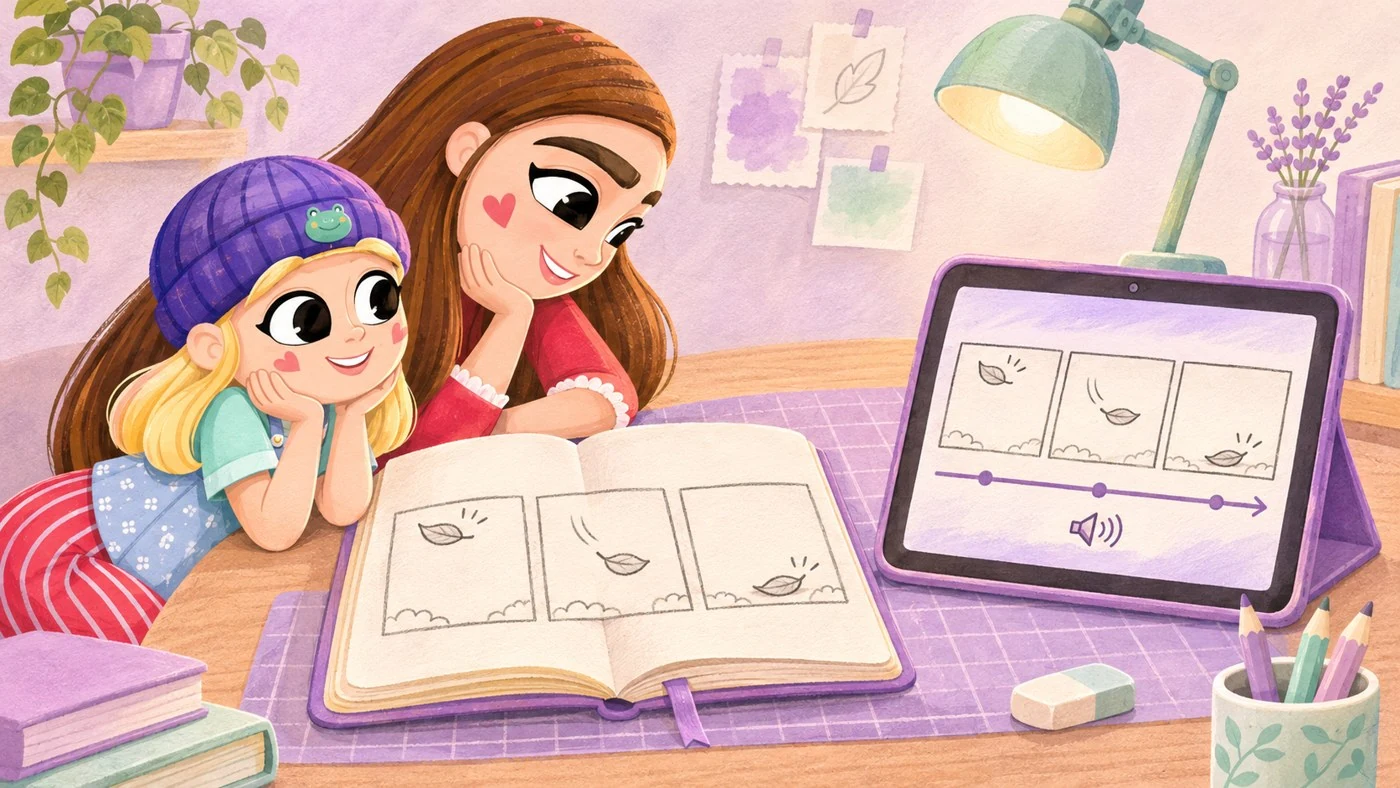
What is an animatic? Storyboard pictures played in time
An animatic is a working sequence in which storyboard pictures play for chosen lengths of time. It may include…
When a child skips picture-book pages: follow their interest
If a child skips several picture-book pages, you do not have to turn straight back to the beginning. You can p…
What is a storyboard? One finished picture is not a finished cartoon
A storyboard is a visual plan of shots. It shows what we will see, in which order and how one moment connects …
 Free