




Reading with a child who does not want to answer questions
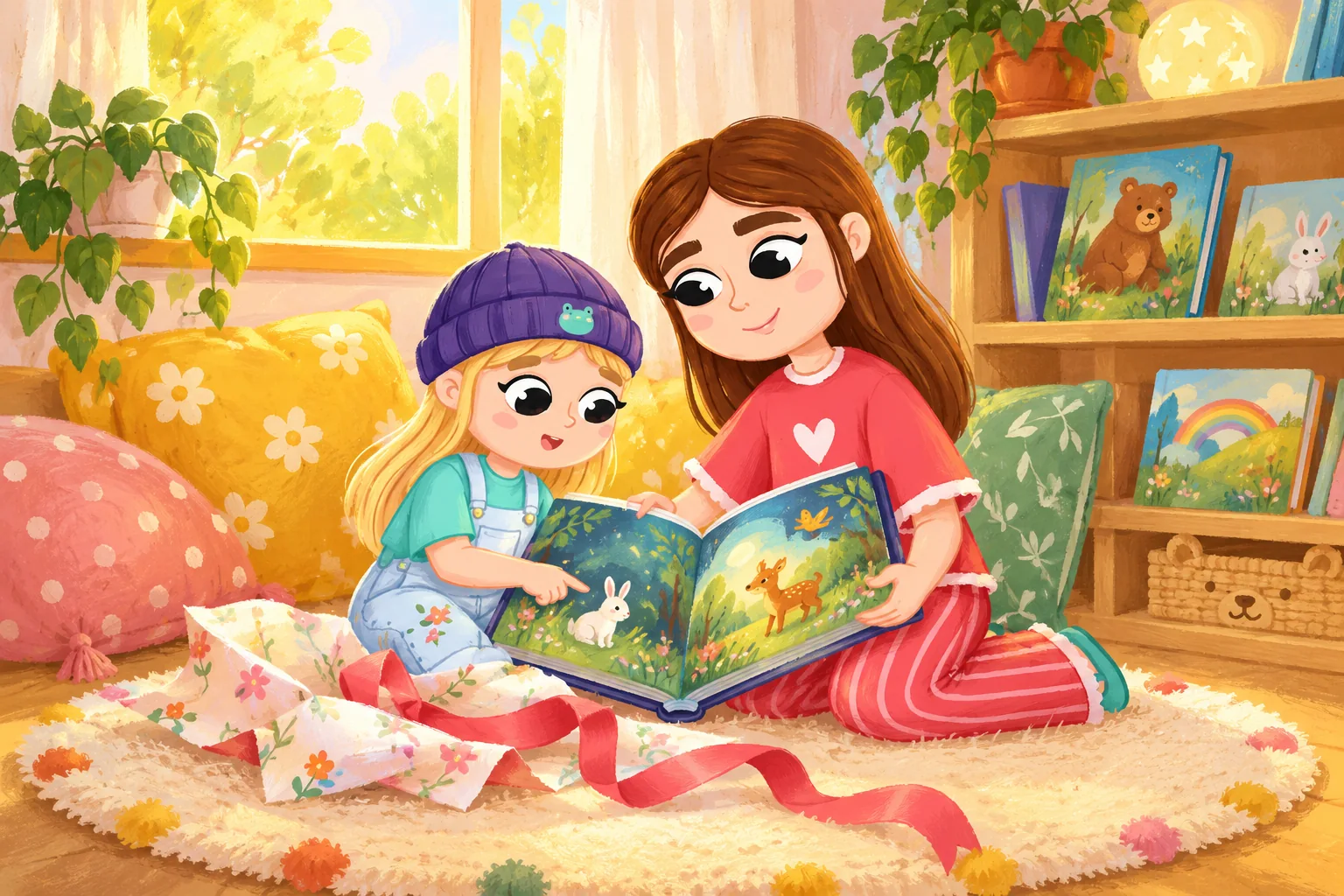
Shared reading does not require a child to answer questions or retell the plot. You can look at pictures, listen, point or sit quietly together.
 Nina Bakalová12 October 2026 · 4 min read

Shared reading does not require a child to answer questions or retell the plot. You can look at pictures, listen, point or sit quietly together. If every page starts to feel like a quiz, try fewer questions and a short comment of your own. Family reading is time with a story, not a performance to assess after every sentence.
Imagine an open book followed by three questions: Who is that? What are they doing? Why do they look like that? A child might be looking closely without wanting a conversation at that moment. Silence alone does not tell you what they took from the story. These are ideas for everyday family reading, not a developmental assessment or therapy programme.
What can I say instead of asking a question?
Mention one thing you noticed: “I like that tiny house on this page.” Then leave space. Your child might add something, point or turn the page. You do not need to fill every pause with another question.
You can also share a thought: “I think I would sit beside that tree.” This is an invitation rather than a demand for the correct answer. If your child wants to talk about a different detail, you do not have to steer them back to the topic you planned.
Is it okay to explore just the pictures?
Try looking at one spread together. Notice where the characters are looking, a detail in the background or something that has changed since the previous page. You do not have to name every object or explain every detail.
With picture books about feelings, avoid making each face a compulsory guessing task. You might say, “It looks as if she does not want to go any further right now.” A character does not need to become a test card, and a child does not have to describe their own feelings.
What if they keep choosing the same book?
A familiar story may simply be a favourite. Instead of requiring a new title each time, change one small part of the experience. Look at the background on one reading, choose the funniest picture on another, or let your child show you where to begin.
You do not have to reach the final page. The book can stay at a favourite scene and continue tomorrow. A family bookshelf can include well-known favourites alongside new discoveries. The number of different titles finished is not the only thing that matters.
What could a short reading session look like?
Choose a place and a book together. Start with one brief comment. Let your child choose whether to continue with words or pictures. When they want to stop, put in a bookmark. A few pleasant pages are a complete shared moment, rather than a failed attempt at finishing a chapter.
In a bilingual family, you can talk about the pictures in the language that feels comfortable. Translating every sentence is not a requirement. Previewing a spread in a library or bookshop can also help you decide whether the amount of text suits the experience you want.
If the book has instructions for an activity, keep them optional for leisure reading. You can enjoy a story without completing every prompt. School reading tasks have their own purpose; your relaxed time together does not need to copy their format.
Where does TAMITOS fit?
TAMITOS publishes Príbeh porozumenia, our own story of Ela and Lumi. The product discussed here is the Slovak edition; a Czech edition is a separate product. This article does not announce an English edition. If the language suits your family, begin with a picture that interests your child and take the story at your pace. We recommend it as a book, not as a substitute for professional support.
Frequently asked questions
Should I stop asking questions altogether?
No. A question can be enjoyable when your child wants a conversation. Notice whether it opens one or creates pressure to respond.
Can we read together if my child does not speak?
Shared time can involve listening, pictures and pointing. A spoken answer is not a compulsory part of family reading.
How many minutes should we manage?
This guide sets no minimum. Choose a length that works for you, and stop earlier if you want to.
Sources and further reading
Reading Rockets: Reading with Your Child provides resources on shared reading. NCTE: Read Together also describes child choice and rereading. The example comments and short session above are TAMITOS editorial suggestions.
More ideas for family time
Continue with our family guides: TAMITOS book 1 or book 2: what is published and what is a preorder?, Autumn outdoor games: 5 ideas for a short walk with children.
A related guide: Reading with two children of different ages.
A related guide: The same book again: sharing a child's favourite.
For a practical next step, see our related guide: A book gift for a child who cannot read independently yet.
Mom of two and co-founder of TAMITOS. For several years I have walked alongside our daughter on the autism spectrum, sharing real experiences from everyday life to bring more understanding and practical information to parents and everyone around them.
More articles
SDH subtitles: more than the spoken dialogue
SDH subtitles give deaf and hard-of-hearing viewers text for dialogue and important sound information, such as…
A child's first cinema visit: what to check
Before a child's first cinema visit, check the conditions of the particular screening as well as the film. Sou…
A book gift for a child who cannot read independently yet
A child does not need to read printed words independently to enjoy owning a book. Choose a gift around their i…
 Free